

Welcome to Fearless Leadership, a new part of Always Starting. This is where I will share what I am learning about leading people, developing their strengths, and knowing when to get out of the way.
On October 7, I closed my HSMAI DC keynote on the future of commercial leadership with the reflection below. I want it to be the first piece here because it asks the question I keep coming back to: what does my leadership make possible when I am not in the room?
For years, I have used the analogy of an air traffic controller when I talk about leadership.
Stay in the tower.
From there, you can see what is taking off, what is landing, what is circling, and what might be getting dangerously close to something else. You have a level of visibility that the people on the ground simply do not have.
But what happens when the air traffic controller leaves the tower?
Suddenly they are down on the tarmac moving baggage, directing planes, answering questions someone else can answer, solving problems someone else should solve. And meanwhile, who is watching the airspace?
I still believe in that analogy. Leadership requires altitude. But recently I started thinking there may be an even higher expression of leadership.
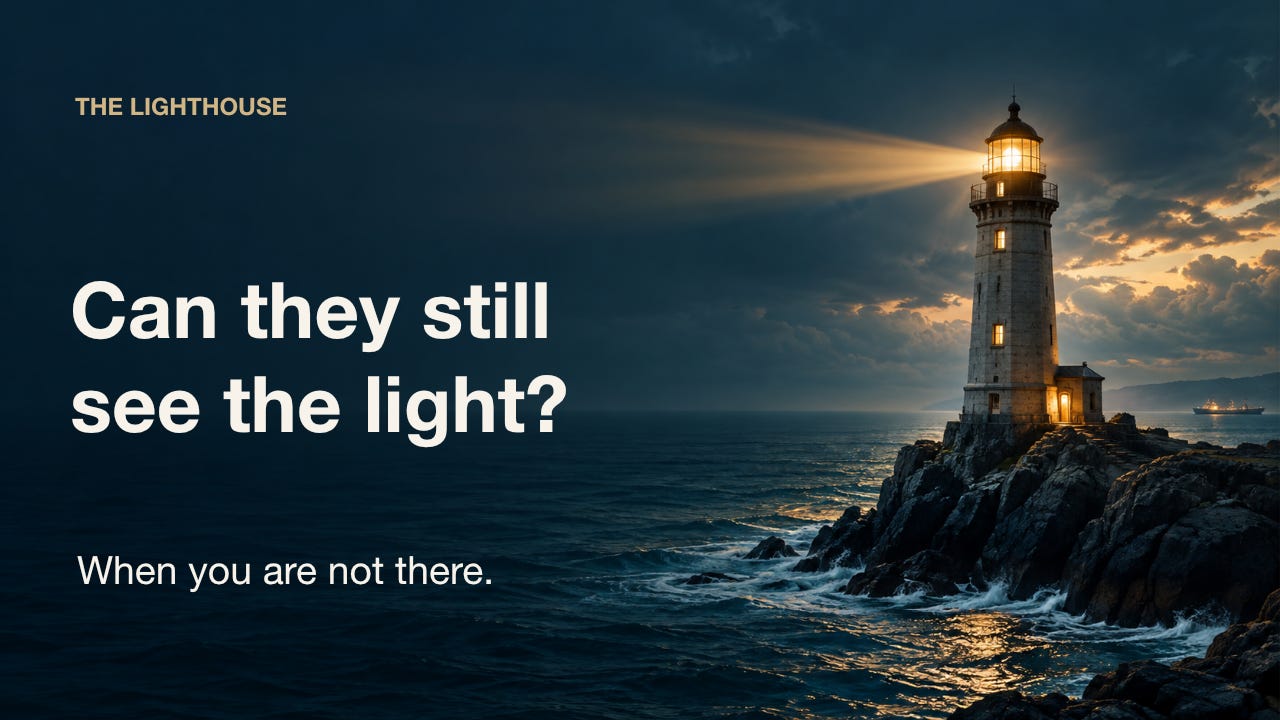
The lighthouse.
Think about what a lighthouse does. It stands steady. It is anchored. It provides direction. In the darkest conditions, you can see it from miles away. In daylight, it can almost disappear. And I love that.
Because the lighthouse does not need to be in the spotlight. It creates the light.
More importantly, the lighthouse does not steer the ship. It does not jump into the water, climb aboard, grab the wheel and say, “Move over. I know these waters better than you do.”
Although, let’s be honest, some of us are thinking, “But I DO know these waters better.” You probably do. That is not the point.
Leadership is not proving that you could steer the ship. Leadership is making sure the people steering it know where they are going, understand the hazards, know what success looks like, and have the confidence to navigate without you standing over their shoulder.
That requires trust, especially when someone chooses a route you would not have chosen. Empowerment is easy when their decision looks exactly like yours. The real test is when it doesn’t.
Is the route wrong? Or is it simply different?
There is a big difference between guidance and control.
Guidance says, “Here is what I see. Here is what my experience tells me. Now you decide.”
Control says, “Give me the wheel.”
And every time you take the wheel, you make it a little easier for someone to wait for you to take it again.
A lighthouse does something different. It stays anchored. The light may move, but the lighthouse does not.
Your people should know your vision. They should know your standards. They should know what you value. They should know where you are going. Those things should still be clear when you are not in the room.
So I want to leave you with a question.
Are you the air traffic controller? Are you the lighthouse? Who do you want to be? And would your team answer that question the same way you do?
Because the ultimate test of leadership is not whether they need your hands on the wheel. It is whether they can still see the light when you are not there.